
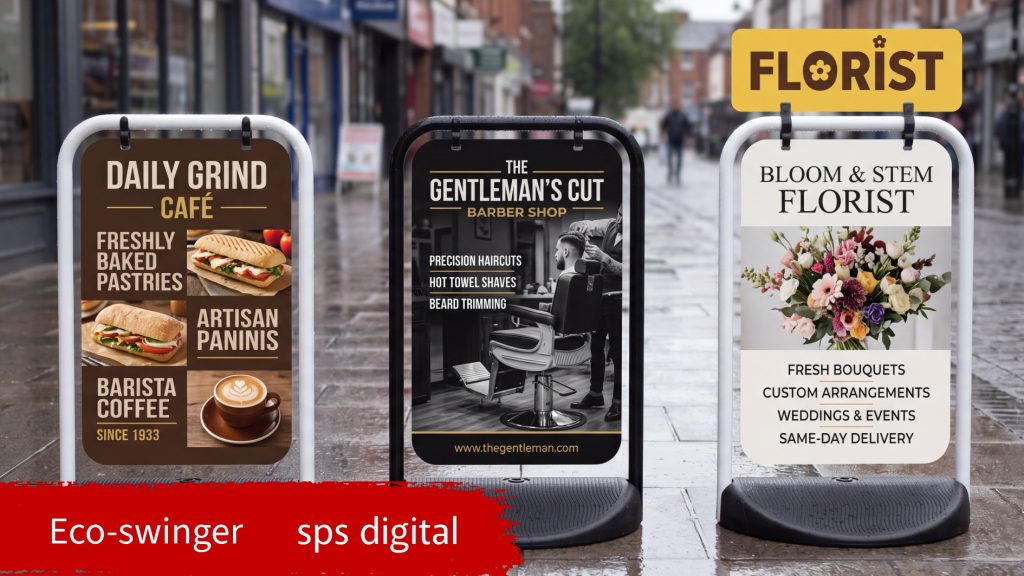
A pavement sign is still one of the cheapest ways to win customers who are already walking past your door. It works while you serve, it needs no electricity, and a good one will last for years. The catch is that there are dozens of styles, and the wrong choice ends up blown over, faded or ignored. This guide explains how we help customers in Biggin Hill, Bromley and across the UK pick the right sign, what to print on it, and how to keep it standing.
Start with the job you want the sign to do
Before comparing frames and bases, decide what the sign is for. Most businesses want one of three things:
- A permanent brand marker. Your name, logo and a short line about what you do. The message rarely changes, so a printed panel makes sense.
- A rotating offer. Weekly deals, seasonal promotions or event dates. You will want a poster pocket so you can swap the print in seconds.
- Daily specials. Soup of the day, today’s coffee, a barber’s walk-in times. A chalkboard is quicker than any printer.
Many cafés and shops end up with two: a printed swing sign for the brand and a chalk A-board for the specials. If you are not sure, start with the permanent marker. It earns its keep every day.
The main types of pavement sign
Swing signs
Swing signs such as the Swinger 2, Swinger 3000 and Eco Swinger have a heavy base with a panel that pivots in the wind instead of fighting it. That movement catches the eye, and it is also why they survive exposed high streets where a rigid board would topple. The base is usually recycled PVC and can be weighted with water or sand.
A-boards
The classic A-frame, like the Booster A-Board, folds flat for storage and gives you two faces to print on. Modern versions use snap frames or magnetic panels so the artwork can be changed without tools. They suit sheltered pavements, shopping centres and doorways.
Chalkboards
A wooden or framed chalk A-board is the natural choice for food and drink. Write it fresh each morning, wipe it clean at night. Pair it with a printed header so the board still carries your brand when the message changes.
Forecourt signs
If you have a car park, garage forecourt or a wide frontage, a larger sign such as the Sightmaster 3 or the Ecoflex 2 gives you poster sizes that can be read from a moving car. These have wide, water-fillable bases and spring-loaded panels built for open, windy sites.
Match the sign to your location
Walk outside and look at three things.
- Wind. Corners, seafronts, retail parks and anywhere between tall buildings get gusts. Choose a swing panel or a spring-loaded forecourt sign, and always fill the base. A light A-board will end up in the road.
- Pavement width. A sign must never block a wheelchair or pushchair. Most councils in England expect a clear route of at least 1.5 metres, and some ask for more on busy streets. Check the footprint of the base, not just the panel.
- Viewing distance. A sign read at two metres by pedestrians can carry more detail than a forecourt sign read from a car at twenty metres. Bigger is not always better; the right size for the distance is what matters.
Choose the display: printed panel, poster pocket or chalk
- Printed aluminium or composite panel. Sharpest finish, longest life, best for permanent branding. We print with UV-resistant inks, so colours hold up outdoors for years.
- Poster pocket. A clear, top-opening polycarbonate pocket that takes a standard A2 or A1 print. Ideal if you change offers weekly. Keep a small stock of posters ready to swap.
- Chalkboard. Free to update, but only as good as the handwriting. Use liquid chalk pens for a bolder, weatherproof line.
What to put on the sign
The best pavement signs say one thing. People walk past in about two seconds, so treat it like a billboard, not a brochure.
- Lead with the benefit or the offer, not the company name. Your name goes underneath.
- Use large type. As a rule of thumb, lettering needs to be around 2.5 cm tall for every 10 metres of viewing distance.
- Keep strong contrast: dark text on a light background, or white text on a deep brand colour.
- Add an arrow or the words “Open” or “Walk-ins welcome” if the entrance is not obvious.
- A QR code works well for menus and booking, but only if it is at least 3 cm square and near eye level.
If you send us your logo and the message, our design team will lay it out to suit the exact panel size, so nothing gets cropped or squashed.
Keep it legal and safe
Pavement signs are allowed on most UK high streets, but the pavement belongs to the highway authority, not the shop. Rules vary by council, and some town centres require a licence or restrict signs to a set zone against the building line. A quick call to your local council’s highways team avoids a removal notice later. Bring the sign in at closing time, keep it out of the way of doorways and dropped kerbs, and never chain it to street furniture.
Looking after it
- Wipe panels with warm soapy water; avoid solvents, which dull the print.
- Top up water-fillable bases in summer and check them in freezing weather, when a little antifreeze or switching to sand prevents cracking.
- Replace faded posters promptly. A tired sign says more about your business than no sign at all.
- Store chalkboards indoors overnight to protect the wood.
Quick comparison
- Exposed, windy pavement: Swinger 2 or Swinger 3000 with a filled base.
- Sheltered doorway, changing offers: Booster A-Board with a poster pocket.
- Café specials: Chalk A-board plus a printed header.
- Forecourt or car park: Sightmaster 3 or Ecoflex 2 in A1 or larger.
- Tight budget, light use: Eco Swinger with a printed panel.
Need help choosing?
We stock every sign mentioned above and print the panels and posters in-house in Biggin Hill, so you can order the frame and the artwork together. Browse the full pavement signs range, or call us on 07933 291310 with a photo of your frontage and we will recommend the right one.
