
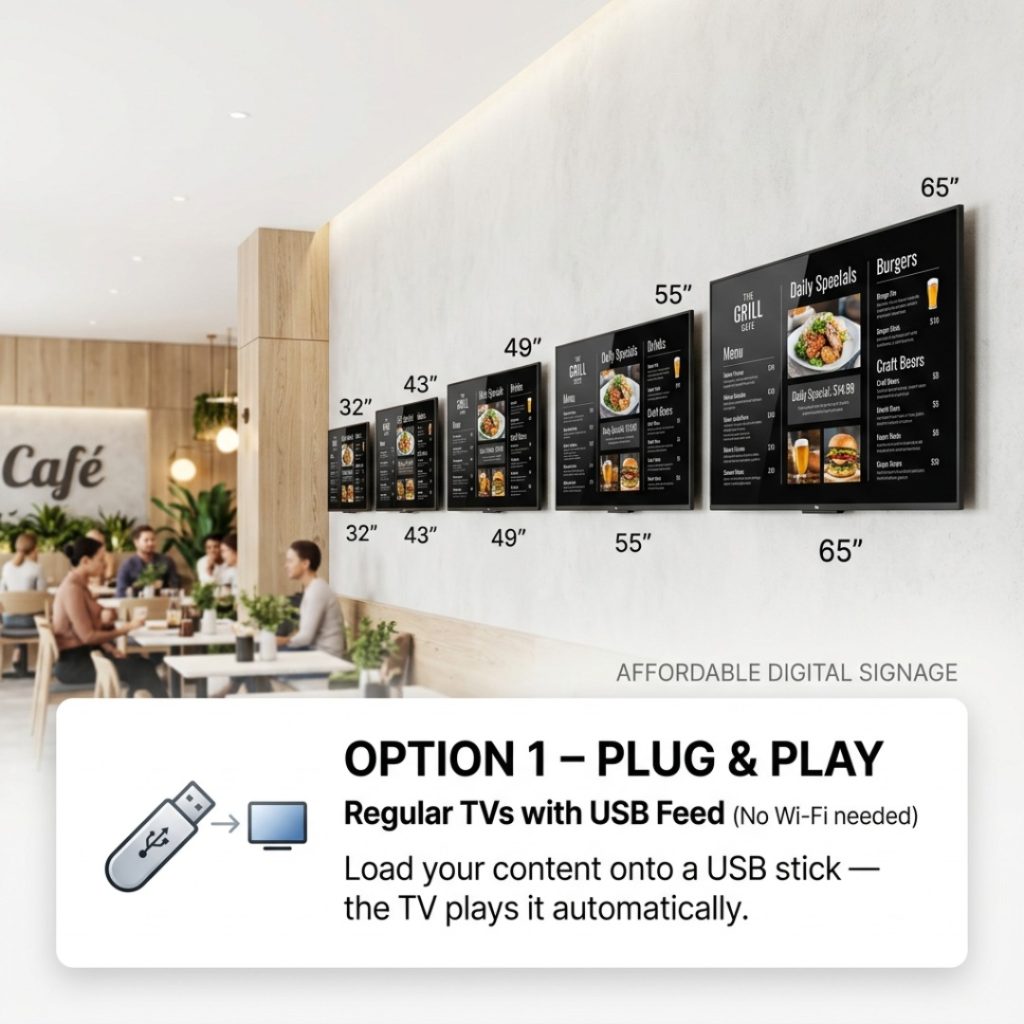
Every café, takeaway and restaurant we work with asks the same question at some point: should we move the menu onto screens, or stick with print? Having installed digital menu screens and printed thousands of table menus for businesses across Kent, Surrey and London, our honest answer is that the two do different jobs. Here is how to decide what belongs on a screen, what belongs on paper, and how to combine them without doubling your costs.
Where digital menu screens win
Prices and items change in minutes
Supplier costs move, dishes sell out, and a printed price is out of date the moment it changes. On a digital menu screen you update the file, and every screen in the shop shows the new price at once. Businesses with more than one site can push the same menu everywhere from one place.
Different menus at different times
Breakfast until 11, lunch until 3, then coffee and cake. A screen switches automatically, so the counter always shows what you are actually serving. You cannot do that with a printed board without a ladder.
Movement sells
A short animation, a rotating “meal deal” panel or a photo that fades in draws the eye far more than a static board. Used sparingly, motion lifts sales of the items you most want to sell. Used everywhere, it becomes wallpaper, so keep it to one highlighted item at a time.
Window screens work in daylight
Ordinary televisions wash out behind glass on a sunny day. Commercial high-brightness screens are built for shop windows: they stay readable in direct sunlight, run all day without overheating, and are designed for continuous use. If you want a menu facing the street, this is the only kind of screen worth buying.
Where printed menus still win
At the table
Nobody wants to squint at a screen across the room while they order. A printed table menu is held in the hand, read at leisure and passed around the table. Laminated or encapsulated menus wipe clean and survive months of daily service.
Takeaway and delivery
A folded takeaway menu goes home with the customer and sits on the fridge. It keeps working long after they have left, which no screen can do. Our leaflets and folded menus are printed on heavier stocks so they survive the journey.
Cost and simplicity
Printing has no electricity, no software, no warranty and no learning curve. For a small café with a stable menu, a well-designed printed board plus a chalkboard for specials is often the most sensible spend.
A feeling of quality
Thick card, a soft-touch laminate or a foil-blocked logo tells customers something about your standards before they taste anything. Print carries texture in a way a screen cannot.
Comparing the costs honestly
- Screens cost more up front (the screen, a media player or Android box, and installation) but almost nothing per change afterwards. They pay back fastest where the menu changes often or where a window display brings in passing trade.
- Print costs little to start, but every price change means a reprint. Businesses that reprint monthly often spend more over a year than the screen would have cost.
- Content is the hidden cost of both. A screen with a menu that never changes is a very expensive poster. Budget for someone to update it, or choose a system with simple remote or offline updating.
A setup that works for most food businesses
This is the combination we install most often, and it suits everything from a village coffee shop to a high-street chicken shop:
- One or two counter screens for the main menu, prices and the daily promotion.
- A high-brightness window screen facing the street, showing three or four hero items and the opening hours.
- Printed table menus for dine-in customers, laminated for wiping.
- Folded takeaway menus by the till and in every delivery bag.
- A pavement sign outside with the offer of the week.
Each piece does one job, and because we design them together, the fonts, colours and photography match across all of them.
Content tips for both formats
- Fewer items per panel. On screen, six to eight items per section is the comfortable limit; on paper, group dishes under clear headings.
- Use real photos of your food, shot in your own kitchen. Stock images are easy to spot and quietly damage trust.
- Show allergen information clearly and consistently in every format. It is a legal requirement in the UK and customers look for it.
- Keep prices in the same position on every panel so they are easy to scan.
- Check the menu from where the customer stands. Type that looks fine on a laptop can be unreadable from the queue.
Mistakes we see every week
- A domestic television in the window. It is too dim in daylight, the warranty usually excludes commercial use, and it tends to fail within a year.
- Too much text. Screens are for headlines, not paragraphs. Put the detail on the printed menu.
- Out-of-date prices on print. If you cannot commit to reprinting, keep prices on the screen and use the print for the dishes and the story.
- Mismatched branding. A modern screen next to a menu designed ten years ago makes both look wrong.
Talk to us before you buy anything
We supply and install digital menu screens, print table menus and indoor menu signs, and design the artwork for all of them from our studio in Biggin Hill. Send us a photo of your counter and window, or call 07933 291310, and we will suggest a combination that fits your menu and your budget.
